

Summary: When oil prices rose sharply and the Nifty 50 fell about 15% during the Strait of Hormuz crisis in early 2026, hybrid long-short SIFs, which are allowed to hold short positions, fell far less than equity and hybrid mutual funds. This post shows the figures and the trade-off that comes with the structure.
What is a long-short SIF?
A Specialised Investment Fund (SIF) is a SEBI-regulated product that sits between a mutual fund and PMS, with a ₹10 lakh minimum. The feature that matters here: a normal equity mutual fund can only go “long”, so it gains when stocks rise. A SIF can run a long-short strategy, holding short positions of up to 25% of the portfolio through derivatives. A short position gains when prices fall, which reduces the portfolio’s loss in a market decline. For a fuller introduction, see What is a Specialised Investment Fund (SIF)?
What happened in the 2026 Hormuz selloff
In late February 2026, military strikes on Iran led Tehran to move to restrict the Strait of Hormuz, the channel through which a large share of the world’s oil flows. Brent crude roughly doubled over the quarter, from about $61 to about $118 a barrel. India imports most of its oil, so the rise meant higher inflation, a weaker rupee and pressure on equities.
The Nifty 50 fell about 15% from its early-January peak to its late-March trough, then partly recovered through April. A long-only equity fund owns stocks and cannot hedge, so its value falls broadly in line with the market in a decline like this.
How the long-short SIFs behaved
Using daily NAV data from AMFI, shown on my Lens SIF tracker, here is how three groups behaved through the same fall, each rebased to ₹100 at the SIFs’ launch:
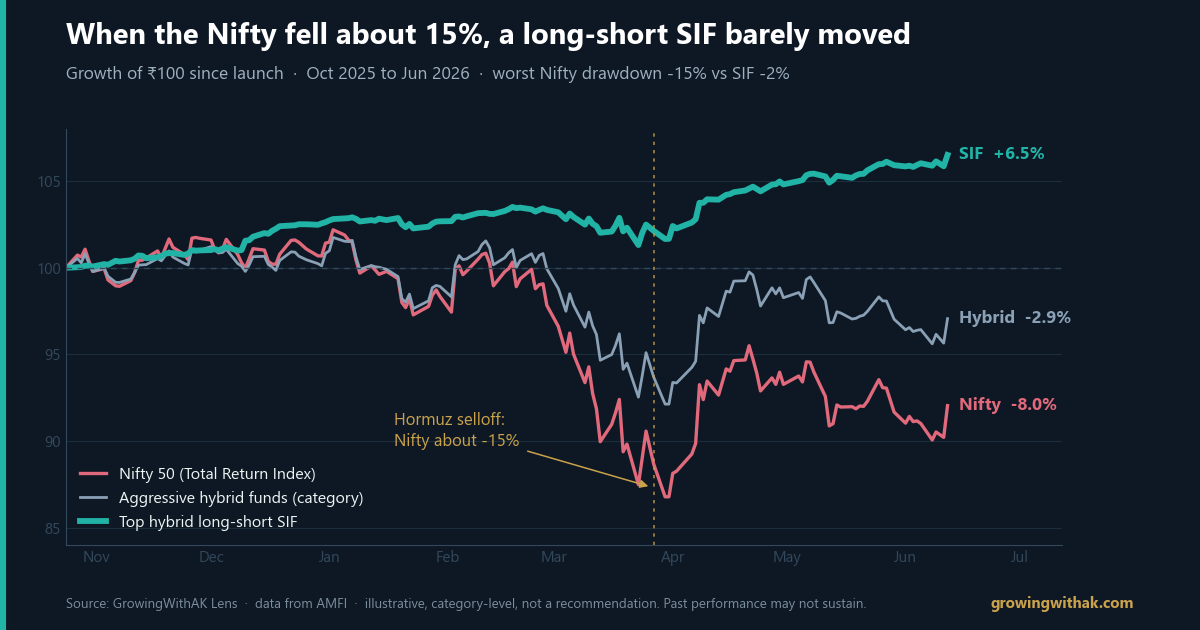
| Through the Hormuz selloff (Jan to Mar 2026) | Worst peak-to-trough fall |
|---|---|
| Nifty 50 (Total Return Index) | about -15% |
| Aggressive hybrid funds (category) | about -9% |
| Hybrid long-short SIFs (stronger funds in the category) | about -2% |
While the index fell about 15%, the stronger hybrid long-short SIFs fell around 2%. The difference also holds over the longer period since these funds launched (late October 2025 to mid-June 2026). Across the hybrid long-short SIF category, returns since launch ranged from about -1% to about +6.5%, while the Nifty 50 fell around 8% over the same period. The top fund in the category is up about 6.5% since its October 2025 launch, and its worst drawdown during the Hormuz fall was about 2%, against about 15% for the Nifty. The short positions offset part of the losses on the equity holdings.
Each SIF’s own line against the Nifty, including its drawdown, is on the Lens tracker, which updates daily.
The trade-off
A strategy that loses less when the market falls usually also gains less when the market rises quickly. The short positions that reduced losses in the Hormuz fall reduce gains in a strong rally, when long-only funds will usually do better. A long-short fund aims for smaller swings in value, not a higher return.
Two further points:
- Very short track record. SIFs only went live in late 2025. A few months of data, including one market fall, is not enough to judge the strategy over the long term.
- Funds vary widely. “Hybrid long-short SIF” is a category, not a single product. Some funds held up well through the fall; others were flat or slightly negative. The choice of fund and manager matters as well as the strategy.
Who this may suit
The Hormuz period shows what the long-short structure is designed for: investors who care about limiting losses in a bad quarter as much as about the headline return. For an investor who can commit the ₹10 lakh minimum, already holds a core mutual fund portfolio, and wants a portion of it managed with downside protection in mind, a hybrid long-short SIF is worth understanding.
Investors still building their first portfolio should start there. You can map a goal with the Goal Planning Calculator, and if you want to discuss whether a SIF has a place in your plan, get in touch.
Do SIFs protect against a market crash?
A long-short SIF is designed to lose less in a falling market because it can hold short positions of up to 25% of the portfolio, which gain when prices fall. In the early-2026 Hormuz selloff, when the Nifty 50 fell about 15%, the stronger hybrid long-short SIFs fell around 2%. This limits losses but does not guarantee against them, and these funds have a very short track record.
How did hybrid long-short SIFs perform during the 2026 Hormuz crisis?
During the Jan to Mar 2026 selloff, when the Nifty 50 Total Return Index fell about 15% peak-to-trough, the stronger hybrid long-short SIFs had worst drawdowns of around 2%. Since these funds launched in late 2025, category returns have ranged from about -1% to about +6.5%, with the top fund up about 6.5% while the Nifty 50 was down. Data is from AMFI, viewable on the GrowingWithAK Lens tracker. Results varied by fund.
What is the catch with long-short funds?
The trade-off for losing less in a fall is usually gaining less in a sharp rally. The short positions that reduce losses in a downturn reduce gains when the market rises quickly. A long-short fund aims for smaller swings in value, not necessarily a higher return than a pure equity fund in a rising market.
How much do I need to invest in a SIF?
The minimum is ₹10 lakh per fund house, measured at the PAN level across all of that house's SIF strategies combined. Accredited Investors are exempt. SIFs are therefore suited to investors who already have a core portfolio and can commit a meaningful lump sum.
Anish Kumar is an AMFI-registered Mutual Fund Distributor (ARN-329356) and AMFI-registered SIF Distributor (SIFD). This article is for educational and awareness purposes only and is not investment advice or a recommendation of any specific scheme. The figures shown are illustrative, drawn from publicly available AMFI NAV data as displayed on the GrowingWithAK Lens tool, and describe categories of funds rather than recommending any one of them. SIFs have a very short live track record. Mutual fund and SIF investments are subject to market risks; please read all scheme-related documents carefully. Past performance may or may not be sustained in the future and is not a guarantee of future returns.